The Lucky Label Is Not an Explanation
FPTU students can use “lucky” to reveal character without implying a game rule, with a clear method for revising captions and dialogue in casino-themed projects.
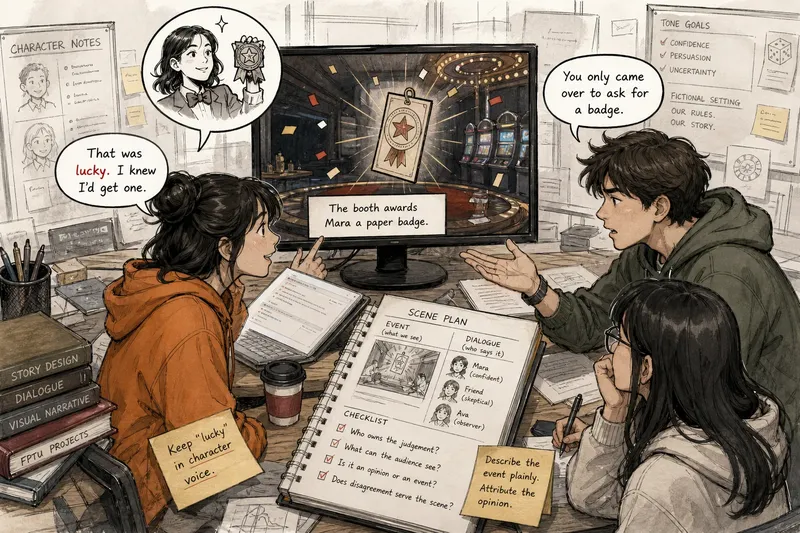
At an FPTU project table, a student types “lucky win” beneath a fictional game result. A teammate asks whether the caption describes a character’s feeling or a rule in the game. The team has one screen, one phrase and a choice about whose meaning the audience should hear.
For FPTU casino-themed student media, that choice is more useful than another familiar casino image. “Lucky” can express a character’s belief; it should not quietly become an explanation of an outcome the project has not defined.
Use “lucky” as a character’s viewpoint
In a film, interactive story or illustrated game concept, a character might call an unexpected result lucky to sound confident, explain their excitement or persuade a companion that events favour them. The word tells the audience how that speaker interprets what happened. It does not, by itself, explain what the fictional system does.
Attribute the judgement clearly. Dialogue, a thought bubble or a caption tied to a named character can mark “lucky” as an opinion. Neutral narration is different: it should describe the event itself, such as a badge appearing or a round ending, unless the project has established a rule that gives the word a specific meaning.
Make the speaker of the judgement unmistakable.
Give disagreement a purpose beyond casino shorthand
A scene becomes more specific when its characters disagree about the meaning of an event. One may call a fictional result lucky; another may regard it as ordinary and question the confidence attached to it. The exchange can reveal pride, uncertainty or an attempt to impress, without asking the audience to learn real gambling mechanics.
Dialogue and timing can make that difference legible. A character might say “I knew it” before learning what a screen displays, then pause when a friend asks what they knew. The scene is about the character’s confidence, not a claim about how games work.
Let the disagreement reveal something about the people in the scene.
Revise a “lucky” caption by checking its job
For each use of the word, decide whether it is character voice, a description of a fictional event or an attempt by narration to explain a rule. Keep the first subjective, describe the second plainly, and clarify or rewrite the third.
- Check the speaker: If a named character says “lucky” and the scene supports a personal opinion, keep it in that character’s voice; if it appears in neutral narration, replace it with a description of the visible event.
- Check the surrounding reaction: If the next line shows the character’s reason or uncertainty, retain the interpretation; if no context explains the word, add a reaction or remove it.
- Check the fictional rule: If the project has stated a rule that defines the result, use the rule’s plain description; if it has not, do not present “lucky” as a system explanation.
- Check the caption’s subject: If it identifies a character’s feeling, attribute that feeling to the character; if it reads like a factual account, name what the audience can see.
- Check the disagreement: If another character’s response clarifies the interpretation, keep the exchange; if everyone repeats the same judgement, give the scene a distinct reaction or cut the repetition.
- Check the project note: If the work explores belief or confidence in an invented setting, say so directly; if the note could suggest an account of real gambling, narrow its claim or consult a suitable subject specialist.
Choose between an attributed viewpoint and a concrete description; do not let an unsupported explanation sit between them.
Work through a caption edit with concrete inputs
Imagine an invented FPTU team has one screen showing a paper badge, one caption reading “A lucky win”, and one character, Mara, who has not explained what the badge means. The team wants the scene to show that Mara is eager to impress a visiting friend. These are the scene’s starting inputs, not an account of a real project.
First, the writers identify the caption as neutral narration. That choice makes “lucky” sound like a property of the game, although the story has stated no rule about luck. They replace it with “The booth awards Mara a paper badge.” The observable result is clear: the audience sees a badge awarded, but the line no longer conveys Mara’s eagerness.
Next, they keep that plain description for the event and add a separate line of dialogue: “That was lucky. I knew I’d get one.” Her friend replies, “You only came over to ask for a badge.” The audience can now see the badge, hear Mara claim good fortune and notice the gap between her confidence and the ordinary event. The decision is to keep “lucky” in Mara’s attributed dialogue, not in narration, because that preserves her attitude without inventing a game rule.
Which wording choices make the distinction clear?
Can “lucky” stay in a character’s dialogue?
Yes, when the scene makes it a character’s belief, mood or attempt to impress someone. In neutral narration, the same word may sound like an explanation rather than an opinion.
What can replace “lucky win” in a caption?
Name the visible event, such as a character receiving a badge or a screen displaying a result. If the caption needs to convey emotion, attribute that feeling to the character.
Do characters need to agree about the result?
No. A different reaction can show how characters interpret the same event, provided the disagreement serves the scene. Keep the focus on their beliefs rather than implying that one reaction explains real gambling.
What should an FPTU project note clarify?
State the creative focus, such as confidence, persuasion or a character’s interpretation of an invented outcome. If the project could be mistaken for an explanation of real gambling, say plainly that its events and rules are fictional.
Make the final edit identify who owns the judgement
Read each caption and line aloud. Ask whether it reports an event or interprets one, and check whether the wording makes that distinction audible. The audience should be able to tell what occurred, who calls it lucky and what the word reveals about the speaker.
For an FPTU casino-themed student project, the useful question is not whether “lucky” sounds convincing on its own. It is who makes that judgement and what the scene lets the audience see alongside it. Keep the event concrete and the opinion attributed; the adjective can then do character work without posing as a rule.