How to Write a Casino Game Rule for an FPTU Student Project
Write a casino game rule for an FPTU student project with clear inputs, turn order, outcomes and edge cases, so players can follow the mechanic unaided.
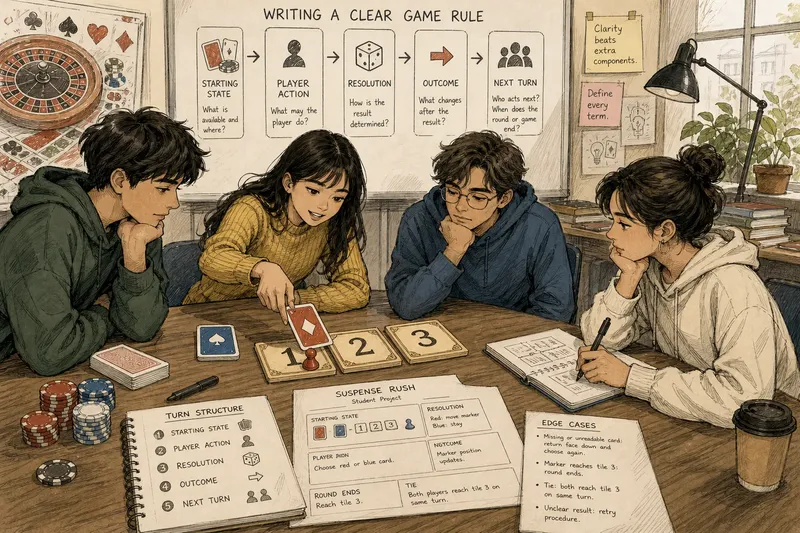
A player draws a red card, places it beside a numbered tile and asks whether the turn is over. A well-written casino game rule answers that question without relying on the designer standing nearby. For an FPTU student project, the rule should specify what players may do, how a result is determined and what happens next.
A casino game rule needs a complete turn structure
Start with the smallest repeatable unit of play: a turn. Define its beginning, the player’s available action, the method for resolving that action and the point at which control passes on. If a player can make more than one choice, state when each choice is made and whether it can be changed.
A useful rule can be read in this order:
- Starting state: What cards, tokens or other components are available, and where do they begin?
- Player action: What may the active player do, and what must they choose?
- Resolution: Which visible procedure determines the result?
- Outcome: What changes in the game state after that result?
- Next turn: Who acts next, and when does the round or game end?
Keep the same term for each component throughout. If the rule calls a piece a token in one sentence and a chip in another, a player may reasonably expect two pieces. Clarity is cheaper than an extra component.
Specify random results and player choices separately
When chance is part of the mechanic, describe the randomising method and its possible results. For a card draw, say which deck is used, whether cards are returned before another draw and what each card means. For a spinner or die, explain how ties, unclear results or a component landing between outcomes are handled.
Separate that procedure from the player’s decision. “Choose a tile, then draw a card” gives a clear order; “draw or choose a tile” does not explain whether the player may do both, or when the choice becomes final. If a player can pass, say what passing changes and whether the turn ends.
Do not use vague terms such as “win,” “lose” or “bonus” without defining their effect. State whether a result adds a point, moves a marker, ends the round or simply changes the next choice. A casino theme may supply the visual vocabulary, but the rule still needs ordinary operational language.
Write outcomes and edge cases into the rule
A rule is incomplete if it describes only the most convenient result. Identify the situations that could interrupt the normal turn: an empty deck, a tie, an invalid choice, a player with no tokens, or a component that cannot be read clearly. You do not need a paragraph for every unlikely accident, but players should not have to invent a ruling during play.
Use explicit conditions and consequences. “If the two cards match, return both to the discard pile and end the turn; otherwise, move the marker to the space shown on the card” is easier to apply than “matching cards cancel.” The second phrase sounds crisp and leaves the central question unanswered.
Decide how the game ends as carefully as how it begins. Name the ending condition and explain how to resolve a tie. If the activity is designed as a short classroom demonstration, the rule can end after a stated event rather than imitating a full casino game.
A worked rule makes each decision visible
Say an invented FPTU group is designing a fictional card-and-tile game about suspense. Its labelled inputs are one red card, one blue card, a row of three numbered tiles, and a marker placed at the first tile. The group wants each turn to offer a simple choice and a visible reveal.
They write the rule in this order. At the start of a turn, the active player chooses either the red or blue card. The player then turns it face up: red moves the marker one tile to the right, while blue leaves it where it is. If the marker reaches the third tile, the round ends; otherwise, the other player takes a turn. If the chosen card is missing or cannot be identified, the player returns it face down and chooses again. If both players reach the third tile on the same turn, the round is a tie.
The resulting rule has a defined input, action, resolution, state change and ending. The group can now decide whether the fixed card effects support its intended suspense: the red card advances the marker, while the blue card creates a pause. That is a design choice the group can discuss, not a claim about real gambling or player behaviour.
Which rule details should students check?
How should a turn begin?
Name the starting position and identify who acts first. If the start depends on a draw or other random result, specify the procedure and how a tie is resolved.
What happens when a result is unclear?
State what players do when a card, die or spinner result cannot be read. A retry, a turn-ending result or an instructor ruling can all work, provided the rule names one consistent response.
How do players know the game has ended?
Give a visible ending condition, such as a marker reaching a named space or the final card being drawn. Explain what players do if that condition produces a tie.
Should the rule include fictional credits?
Only include them if they serve the project’s design question, and make clear that they have no real-world value. If they do not affect a choice or outcome, leave them out of the rule.
Check each rule before sharing it
Read the rule as a player who has not heard the designer explain it. For each item, make the decision that follows from what the text actually says.
- Starting materials: Check that every named card, token and board space is present; if all are listed, begin play with that set, and if an item is missing, add it to the component list or remove its rule.
- Turn order: Check that the rule names the first player and the next player; if both are clear, follow that order, and if either is unclear, add an explicit turn sequence.
- Player choices: Check that each choice states when it is made and whether it can be changed; if both points are clear, use the choice as written, and if either is missing, specify the timing or revision limit.
- Random procedure: Check that the rule identifies the deck, spinner or die and explains ties or unreadable results; if every result has a response, use that procedure, and if one does not, add a retry or other defined outcome.
- State changes: Check that each result names what moves, changes or stays put; if the board state is explicit, update it accordingly, and if it is not, replace broad words such as “bonus” with the exact effect.
- Ending condition: Check that players can see when a round or game ends; if the condition and tie resolution are stated, stop at that point, and if either is absent, write the missing ending rule.
- Theme language: Check that fictional credits or casino-style labels cannot be mistaken for real value or advice; if their fictional status is clear, retain them if useful, and if not, label them plainly or remove them.
These checks improve the written mechanic; they do not turn a classroom prototype into a claim about real-world odds.
Keep the casino theme in the presentation
Once the mechanic is clear, the group can decide how much casino imagery it needs. A roulette-inspired colour scheme, a card-table layout or a restrained reveal animation may support the concept, but none should obscure the action or its consequence. Put instructions near the relevant component, use labels consistently and distinguish decorative signals from signals that change play.
For an FPTU student project, the strongest casino game rule is the one classmates can follow without a private explanation from its author. The final useful check is simple: give the rule to a reader who has not seen the prototype, then revise any sentence that leaves them asking what to do next.