Choosing Casino Media for a Close-Reading Lesson
Choose casino media for a close-reading lesson by matching its form to the task, checking access and suitability, and giving students a focused way to respond.
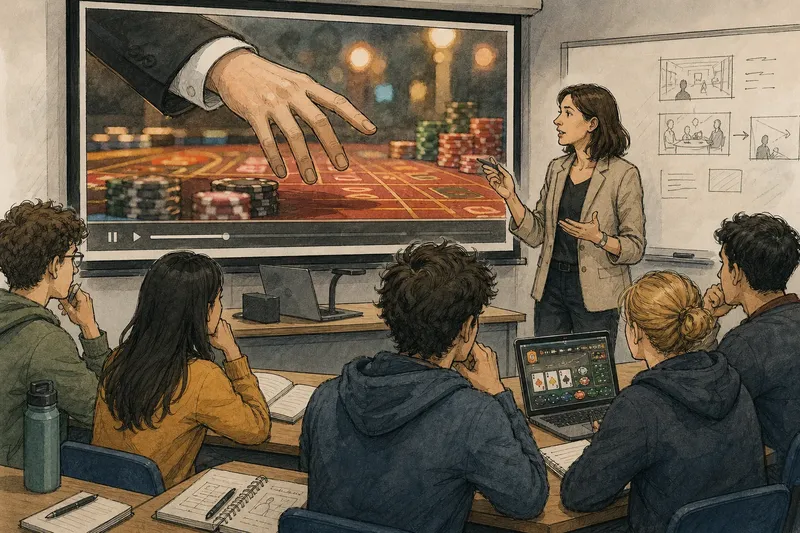
A student pauses a casino-themed film on a close-up of a hand hovering over a gaming table. The lecturer asks the class to consider why the scene delays the decision. For a close-reading lesson, casino media works best when its form gives students something specific to investigate, rather than merely providing a suitably dramatic room.
Casino media for close reading depends on the task
Before choosing a clip, decide what kind of thinking the lesson requires. A study of film editing needs a sequence of shots; a discussion of visual hierarchy may need only one frame. If students are comparing how different media invite an audience into a casino setting, a film scene and a game interface may offer useful contrasts, but they are not interchangeable sources.
A scripted scene is organised around characters and story. A game interface arranges buttons, prompts, symbols and feedback for someone expected to interact with it. A poster or advertisement compresses its message into a selected image and a short pitch. Each form gives students a different object of study: narrative, interaction or promotion.
Choose the form that lets the class address the actual question. A film scene is a poor substitute for an interface if the task concerns how a player is prompted to act.
Match each media form to what students can examine
For film, students might examine shot size, camera movement, performance, sound, editing or the way characters occupy a room. A still can support discussion of composition, costume and visual emphasis, but it cannot show how suspense builds through timing.
A game interface makes different details available. Students can examine how instructions are worded, which controls are prominent, what appears before an action and how the screen responds afterwards. A recorded capture may help if the class needs to follow a sequence, while a static screen is more suitable for inspecting layout. Treat the interface as a designed artefact, not as evidence of how every player behaves.
Promotional material is useful for studying selection and appeal: what the image foregrounds, what language accompanies it, and what kind of audience the presentation seems to address. It does not show the full experience that follows an invitation. A poster is not a miniature documentary, despite its occasional confidence.
Check suitability and access before selecting the item
Casino-themed media may include gambling imagery, mature content, violence or language unsuitable for a particular class. Review the chosen material and follow relevant university guidance. If its suitability is uncertain, select another item or consult the appropriate university contact.
Access matters just as much as content. Check that the clip plays in the classroom, captions are available where needed, and the relevant details can be seen or heard. For an interface, confirm that students can inspect the screen at a useful size and that any sequence needed for the task is available. If an item cannot be accessed by everyone, arrange an appropriate alternative.
Use these checks to make a concrete selection decision:
- Check whether the learning question names a feature students can examine; if it does, choose material that contains it, and if it does not, narrow the question before selecting an item.
- Check whether the relevant detail is visible or audible in the chosen excerpt; if it is clear, retain the excerpt, and if it is obscured or fleeting, choose a clearer section or a still suited to the task.
- Check whether the task concerns a sequence or a single arrangement; if change over time matters, use a playable clip or recorded interface sequence, and if one moment is enough, use a still or screen capture.
- Check whether sound carries information students need; if it does, confirm that the audio and captions support access, and if it does not, choose a version whose visual details carry the task or provide an accessible alternative.
- Check whether the item’s purpose matches the question; if the task concerns storytelling, select a scripted scene, and if it concerns promotional appeal, use promotional material rather than treating the formats as equivalent.
- Check whether the material suits the class under applicable guidance; if it does, proceed with the planned item, and if it does not or remains uncertain, replace it or seek advice through the relevant university process.
- Check whether students can access the item in the teaching space; if they can, use the planned format, and if they cannot, provide an accessible alternative or choose a different item.
Build a prompt around the medium’s distinctive features
Prompts should direct attention to what the selected form actually does. For film, ask how the sequence of shots shapes the viewer’s sense of a character. For an interface, ask which on-screen choices are made prominent and what the wording asks the user to do. For an advertisement, ask what image or phrase carries the invitation.
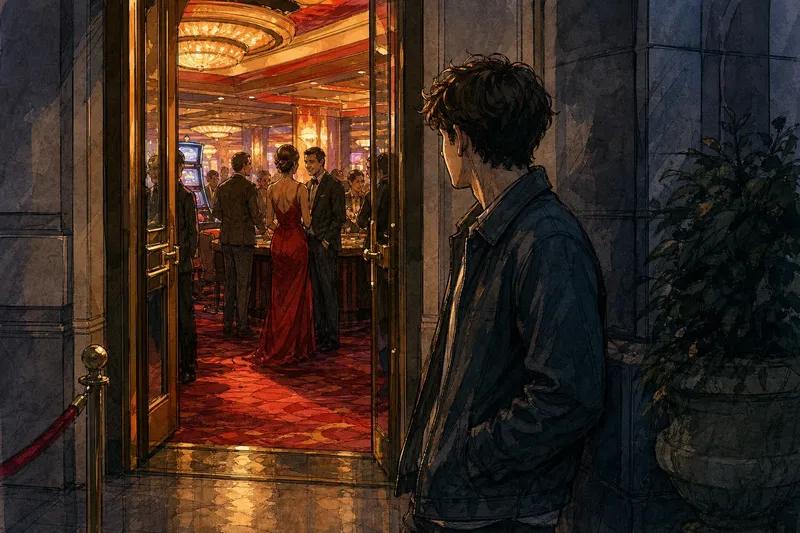
Say a lecturer has an invented film scene showing a casino manager at a bright table, with a staff member standing near a doorway. The class’s task is to consider how the scene suggests authority. Students first note the manager’s position and the staff member’s distance from the table; then they track who speaks and who listens; then they connect those choices to a possible reading of the hierarchy. Their answer can cite the framing and dialogue while recognising that the scene is fictional, not evidence about real workplaces.
That prompt differs from one for an interface. Students could follow how a hypothetical screen displays an instruction, a control and a response, then discuss how the arrangement guides attention. The analysis concerns design choices visible in that screen, not a general claim about what users think or do.
How do you choose casino media for close reading?
What makes a casino scene useful for close reading?
A scene is useful when it contains a feature that students can connect directly to the question, such as a change in camera distance or a shift in sound. If the lesson concerns interface design, a film scene may not contain the evidence needed.
Should students analyse a whole film or a short excerpt?
A short excerpt can focus attention on a formal choice, while a longer viewing may be needed to discuss a developing story or character. Choose enough material to make the task intelligible without adding scenes that do no work for it.
How can students analyse a game interface?
Ask them to examine visible elements such as labels, controls, prompts and screen layout, and to describe how those elements are arranged. Keep claims tied to the interface itself rather than assuming that every user responds in the same way.
What should you do if a clip is unsuitable or inaccessible?
Select another item that supports the same learning aim, or use a different format such as a still or accessible screen capture. Follow relevant university guidance and arrange an alternative where needed.
Keep claims within the boundaries of the media
Close reading can support claims about representation, composition, narrative, interface design and promotional framing. It cannot, by itself, establish how casinos operate or how visitors behave. A fictional scene, advertisement or game screen is an authored representation with its own purpose and limits.
For casino media for close reading, select an item whose form fits the question, whose content is suitable, and whose relevant features students can access. A plain interface may be more useful than an elaborate film sequence when the lesson concerns prompts and controls.
Before class, name the feature students should be able to discuss and check that it is present in the material. If it is not, choose a better-matched item; imagination is a poor substitute for a missing screen element.